A doctoral thesis uses electromicrobiology to address a sustainable solution for the removal of nutrients and emerging contaminants from wastewater in small communities
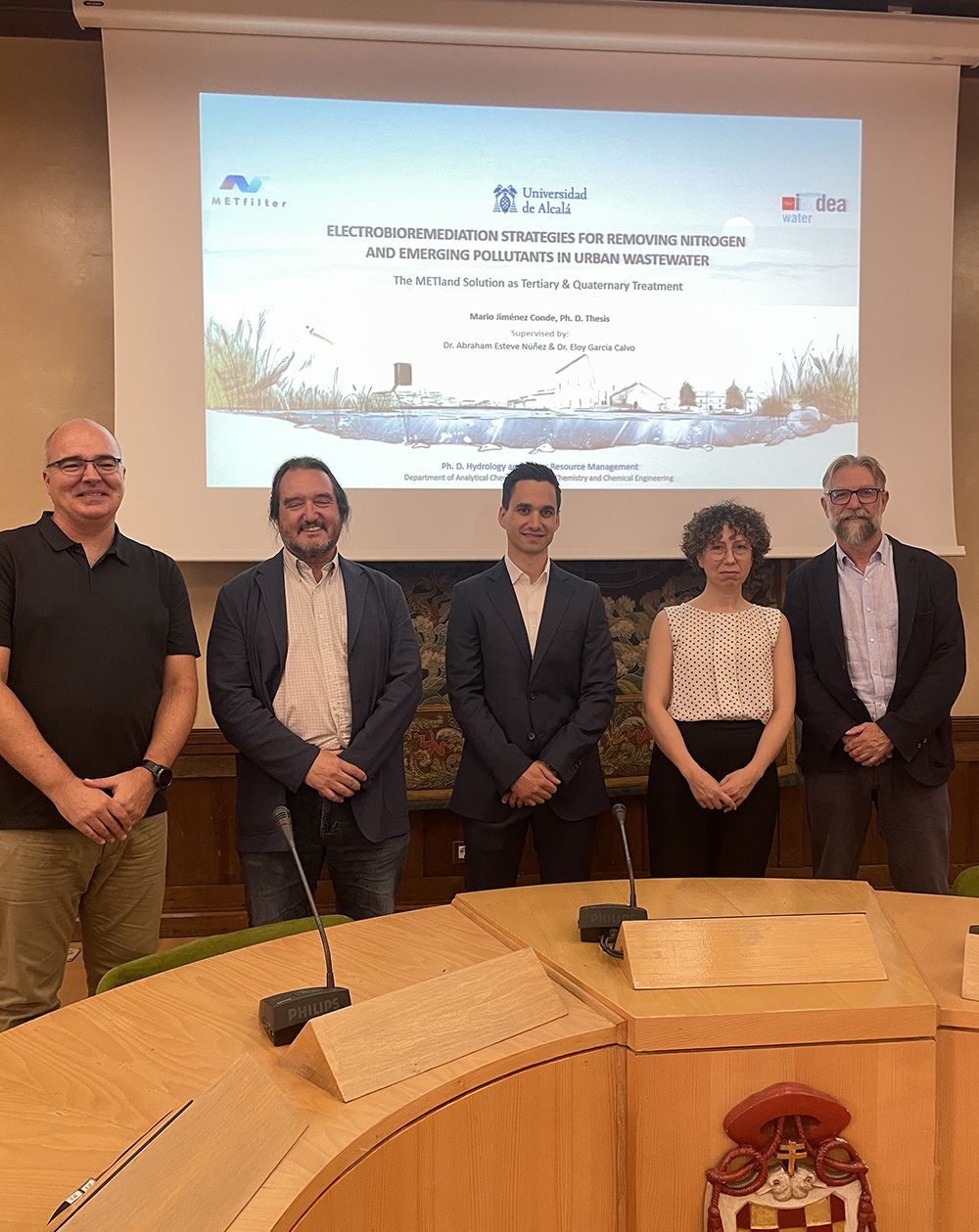
The doctoral thesis defended by Mario Jiménez Conde, co-financed by the Industrial Doctorate programme of the Community of Madrid and the company METFILTER, S.L. has been developed at IMDEA Agua. Under the title Electrobioremediation strategies for the removal of nitrogen and emerging contaminants in urban wastewater: the METland solution as tertiary and quaternary treatment, the work has been supervised by professors Abraham Esteve Núñez and Eloy García Calvo.
The increase in the world population has generated an increase in the demand for quality drinking water which, in addition to the effects of climate change, exerts great pressure on water resources. This scenario poses challenges, particularly for small communities that wish to purify water in a decentralized, efficient and profitable way. Recent environmental legislation points out the need to integrate tertiary and quaternary treatments to protect water bodies from the arrival of emerging nutrients and contaminants.
The doctoral thesis defended by Jiménez Conde on July 24 at the University of Alcalá explores, for the first time, the use of METland® technology on a demonstration scale in wastewater treatment plants in small communities. This sustainable technology is being marketed by the company METfilter, co-financing the industrial doctorate.
METland® systems are biofilters that replace the traditional bed with electrically conductive materials; the action of electroactive bacteria is enhanced, capable of improving the efficiency of the purification process, such as a low footprint of the implantation surface, without external energy inputs, or generation of secondary sludge.
Research has demonstrated the efficiency of METland® technology in nitrification and electrodenitrification processes for real waters with low organic load, a situation typical of wastewater treatment plant effluents or nitrate-contaminated aquifers. Furthermore, the elimination of up to 52 emerging pollutants – antibiotics, hormones, anti-inflammatory drugs, etc. – in real effluents has made it possible to obtain neutral water for toxicity bioindicators such as algae, assuring a clean discharge into the environment.
Jiménez Conde, Mario. Electrobioremediation Strategies for Removing Nitrogen and Emerging Pollutants in Urban Wastewater: The Metland Solution as Tertiary & Quaternary Treatment.
Directors: Abraham Esteve Núñez and Eloy García Calvo.
Program: Hydrology and Water Resources Management
Reading date: 07/24/2024
This doctoral thesis has been carried out thanks to the grant IND2018/AMB-9197 financed by the Community of Madrid.