A single model is not enough: uncertainty in agricultural water management is greater than previously estimated

The Tormes River flowing through Salamanca, Spain. Credit: Selbymay/Wikimedia Commons (CC BY-SA 3.0 ES).
Research led by IMDEA Water predoctoral researcher Héctor González-López, in collaboration with the Joint Research Centre in Ispra and the Euro-Mediterranean Center on Climate Change, has shown that relying on a single computational model for agricultural water management can create a false sense of certainty. The study, published in Agricultural Water Management and focused on Spain’s Tormes River basin, is the first to combine multiple hydrological and microeconomic models within a single analysis. The results reveal substantial differences in projected reservoir storage, with estimates varying by as much as 202 million cubic metres.
The risk of a single perspective
River basin authorities and policymakers increasingly rely on hydroeconomic models to design water management strategies, such as water allocation rules for irrigation and water pricing policies. These models simulate interactions between the hydrological cycle and farmers’ economic decisions. However, the study shows that the model structure itself—the equations and assumptions that underpin a model—is a major source of uncertainty.
To quantify this effect, the research team developed a multi-model ensemble, combining several hydrological simulation tools (including HEC-HMS and SWAT) with different representations of farmers’ decision-making. When applied to the Tormes basin under a range of drought and water pricing scenarios, the ensemble produced markedly different projections. Estimated storage in the Santa Teresa reservoir ranged between 150 and 202 million cubic metres, equivalent to 31–41% of the reservoir’s storage capacity and up to 127% of annual downstream irrigation demand.
The analysis found that the choice of hydrological model is the main driver of this variability, while economic models explain differences within individual scenarios. The divergence is particularly pronounced at the beginning of the irrigation season, a critical period for agricultural planning.
“Our results demonstrate that relying on a single model to make decisions about water allocation or pricing can create a false sense of precision and lead to policies that are not sufficiently robust to cope with the full range of plausible futures, particularly during severe droughts,” explains Héctor González-López, the study’s lead author.
Towards more robust water management
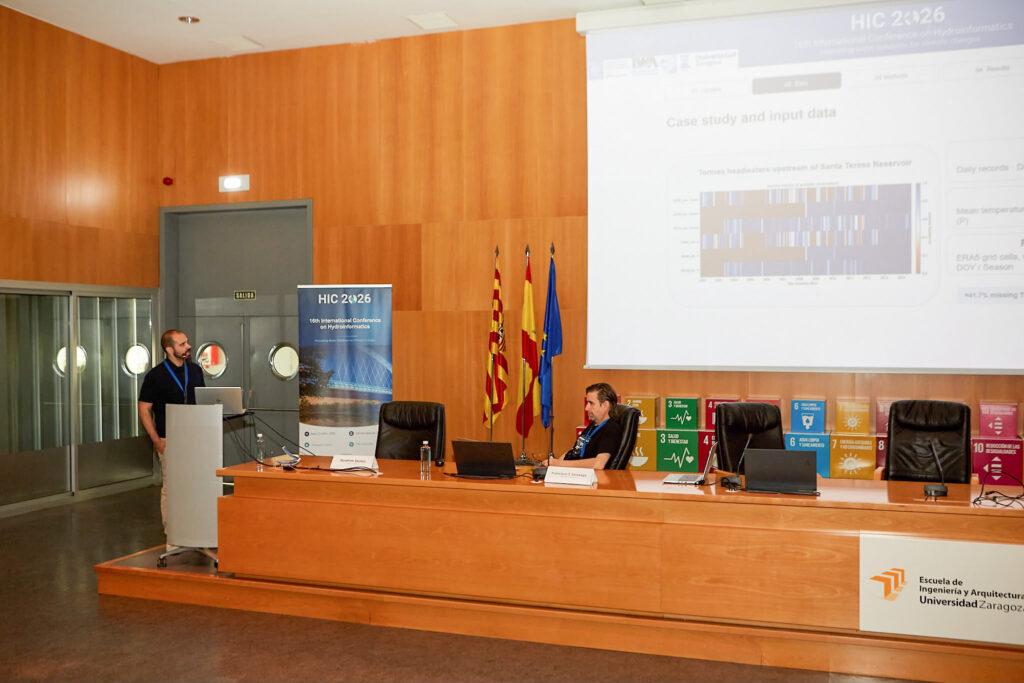
Héctor González-López presenting results related to this research at the 16th International Conference on Hydroinformatics, held in Zaragoza, Spain, from 22 to 26 June 2026.
These findings do not suggest that one model is “right” and the others are “wrong”. Rather, they show that any individual model captures only part of a highly complex reality. The authors therefore argue that assessments of water management policies should systematically incorporate multi-model ensembles. Such an approach provides a more comprehensive view of plausible future conditions and supports the design of more resilient and robust adaptation strategies in the face of drought and climate change.
About the research: a methodology applicable to other basins
The study provides a common methodological framework for consistently integrating and comparing different models. This framework can be transferred to other regulated agricultural river basins in Spain and around the world, strengthening evidence-based decision-making in water management.
In addition to Héctor González-López, the research team included IMDEA Water researchers Francesco Sapino, David Rivas-Tabares and Carlos Dionisio Pérez-Blanco. The study was developed with the support of the following projects:
- TRANSCEND (funded by the European Union’s Horizon Europe Programme under Grant Agreement No. 101084110)
- MARCLAIMED (funded by the European Union’s Horizon Europe Programme under Grant Agreement No. 101136799)
- TALANOA-WATER (funded by the PRIMA Programme supported by Horizon 2020)
- NATURA (Grant CNS2022-135132, funded by the Spanish Ministry of Science, Innovation and Universities, the State Research Agency, and the European Union through the NextGenerationEU/PRTR Recovery and Resilience Plan)
Reference
González-López, H., Hrast Essenfelder, A., Sapino, F., Rivas-Tabares, D., Bodoque, J. M., & Pérez-Blanco, C. D. (2026). Assessing structural uncertainty in water-human systems: A multi-model ensemble approach for agricultural water management. Agricultural Water Management, 333, 110582. https://doi.org/10.1016/j.agwat.2026.110582
El estudio proporciona una metodología común para integrar y comparar distintos modelos de forma consistente, que puede aplicarse en otras cuencas agrícolas reguladas de España y del resto del mundo para mejorar la toma de decisiones sobre la gestión del agua. El trabajo, en el que también han participado los investigadores de IMDEA Agua Francesco Sapino, David Rivas-Tabares y Carlos Dionisio Pérez-Blanco, ha sido desarrollado en el marco de los proyectos:
- TRANSCEND (financiado por el programa Horizonte Europa Europea con el acuerdo de subvención nº 101084110)
- MARCLAIMED (financiado por el Programa Horizonte Europa con el acuerdo de subvención nº 101136799)
- TALANOA-WATER (parte del Programa PRIMA financiado por Horizonte 2020 con el acuerdo de subvención nº 2023)
- NATURA (ayuda CNS2022-135132 financiada por el Ministerio de Ciencia, Innovación y Universidades (MICIU), la Agencia Estatal de Investigación (AEI) y por la Unión Europea a través del programa NextGenerationEU/PRTR (Mecanismo de Recuperación y Resiliencia).
Referencia:
González-López, H., Hrast Essenfelder, A., Sapino, F., Rivas-Tabares, D., Bodoque, J. M., & Pérez-Blanco, C. D. (2026). Assessing structural uncertainty in water-human systems: A multi-model ensemble approach for agricultural water management. Agricultural Water Management, 333, 110582. https://doi.org/10.1016/j.agwat.2026.110582