Micro and nanoplastics kept at bay: an IMDEA Water study shows that membrane bioreactors remove up to 99% of these emerging contaminants from wastewater
Researchers at IMDEA Water have confirmed that membrane bioreactor (MBR) systems are highly effective not only at removing microplastics, but also nanoplastics, a class of contaminants that has been scarcely studied under environmentally realistic concentrations. The study has been published in the journal Separation and Purification Technology

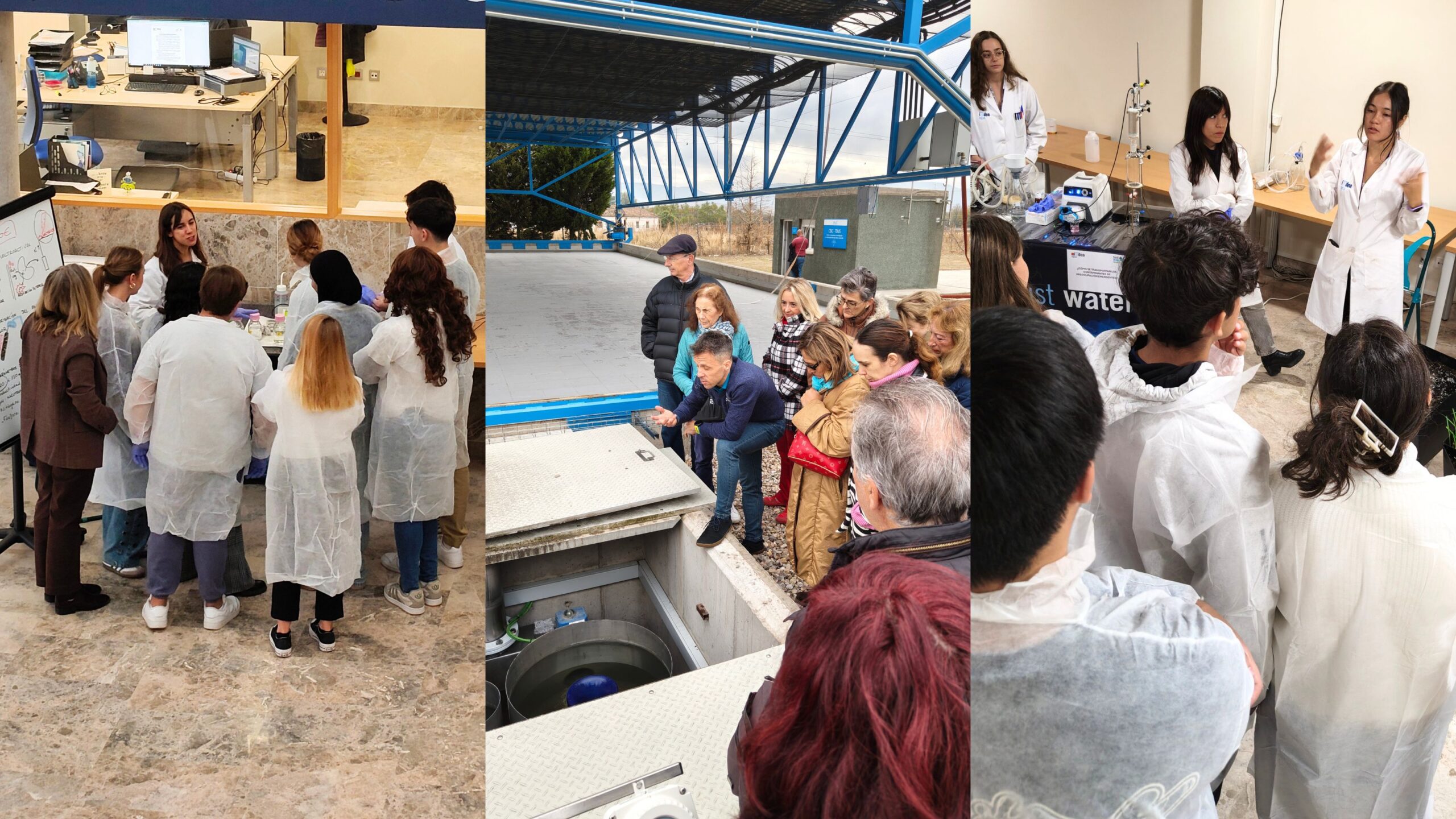
From left to right: Mihai Lomanar, Serena Molina, Junkal Landaburu, Imane Fellahi, Francesca Nonnoi and Ana Rubio. Credit: Elena Mora Cuesta (IMDEA Water).
Micro‑ and nanoplastics are ubiquitous and are also present in the water that reaches wastewater treatment plants. However, most experimental studies assessing their presence do not consider mixtures of plastics of different types and sizes comparable to those found in the environment.
In this context, a team of researchers from IMDEA Water has tested membrane bioreactor (MBR) technology, demonstrating its ability to remove up to 99.99% of micro‑ and nanoplastics and around 97% of organic matter from wastewater. The results have been published in the scientific journal Separation and Purification Technology.
The aim of the study was to reproduce, under laboratory conditions, the processes that take place daily in a full‑scale membrane bioreactor at a wastewater treatment plant. To this end, over a three‑month experimental period conducted at IMDEA Water, an MBR was exposed to wastewater containing concentrations of micro‑ and nanoplastics similar to those found in real wastewater, while a parallel reactor operating without these contaminants was used as a control.
A membrane bioreactor combines two key elements: a biological reactor, in which microorganisms degrade organic matter and transform nutrients, and a filtration membrane, which separates the treated water from the sludge and retains solids, microorganisms, and particles such as micro‑ and nanoplastics.

Imane Fellahi extracting membrane to check the fouling effect. Credit: IMDEA Agua.
The results show that the system maintained high and stable performance throughout the study, producing high‑quality treated water suitable for reuse in irrigation. Analysis of the microbial community revealed that although slight changes associated with the presence of micro‑ and nanoplastics were observed at the beginning of the experiment, the microbial community was able to adapt over time, with no negative impact on the overall performance of the wastewater treatment process.
The study also confirmed that the MBR achieved an overall removal efficiency of 99.99% for micro‑ and nanoplastics. Microplastics did not pass through the membrane, while nanoplastics appeared only in very low trace concentrations, detectable only after the application of advanced preconcentration techniques.
The research also revealed an unexpected finding. One of the main operational challenges of MBR systems is membrane fouling, which reduces efficiency and requires frequent cleaning. In this study, however, the presence of micro‑ and nanoplastics did not increase fouling and even appeared to slightly mitigate it. This effect may be related to the so‑called scouring effect: as microplastics move continuously due to aeration and sludge mixing, they may gently rub against the membrane surface, limiting the accumulation of solids.
“Our work reinforces the role of MBRs as a key technology for addressing emerging contaminants, particularly in the context of the new European directive on urban wastewater treatment,” explains Imane Fellahi, predoctoral researcher at IMDEA Water and first author of the paper. The study also highlights one of the major current challenges in this field: the lack of standardized methods for sampling and detecting nanoplastics at environmentally relevant concentrations.
This article constitutes the first publication derived from Imane Fellahi’s doctoral thesis, developed within the framework of the EMERGING project (Project PID2022‑143233OB‑I00 funded by MICIU/AEI /10.13039/501100011033 and ERDF, EU), and the PIPF‑2022/ECO‑26357 grant funded by the Community of Madrid. This work was made possible thanks to extensive multidisciplinary collaboration between the Membrane Technology Group, the Microbial Ecology Unit, and the Micronanoplastics Unit at IMDEA Water.

Reference:
- Fellahi, I., Landaburu-Aguirre, J., Nonnoi, F., Argudo, M., Cherta, L., Rubio-López, A., & Molina, S. (2026). Removal of mixed micro/nanoplastics from synthetic wastewaters in MBR systems: Influence on process performance and microbial community. Separation and Purification Technology, 395(3), 137940. https://doi.org/10.1016/j.seppur.2026.137940
Contact:
- IMDEA Water Communication and outreach: prensa.agua@imdea.org