


IMDEA Water Mentoring Programme (MIA Programme)
What does the MIA Programme consist of?
The ‘MIA Mentoring Programme’ is part of the Human Resources Strategy for Research (HRS4R), with the dual objective of facilitating the incorporation of new employees and promoting professional career development by strengthening cross-cutting skills and guiding and informing IMDEA Water staff about the options available within and outside the academic world, with a special emphasis on those in the early stages of their professional careers (pre-doctoral researchers, research assistants, technicians, managers and young doctors).
MIA includes two types of mentoring:
- MIA-Career Development Mentoring (CDM). A voluntary programme for participants that will enable both mentors and mentees to improve their skills and abilities.
- MIA-Onboarding Mentoring (OM). This programme is mandatory for mentees and will form part of the induction process already established at IMDEA Water, helping to reinforce it and facilitate the incorporation and integration of new employees at IMDEA Water, as well as helping foreign employees to familiarise themselves with Spanish culture.
What is mentoring within the framework of MIA and what does it aim to achieve?
- Mentoring consists of sharing experiences and knowledge and providing advice.
- Mentoring is based on a two-way relationship where both parties must commit and listen to each other, as well as learn during the process.
- Empathy and trust are essential in the process.
- Open and ongoing dialogue within the couple is the main tool of mentoring.
- MDC mentoring is a guided path of self-understanding, self-awareness, and self-knowledge in which mentees analyse their strengths and weaknesses and achieve personal and professional growth. Mentors guide mentees through this process.
- The role of the mentor within the MIA programme is that of a guide (for the CDM) or integrator (for the OM).
- The OM Programme aims to help new employees integrate by familiarising them with the centre, the people and the resources available to them.
Objectives
Career development mentoring:
Contribute to professional career development
-
- Guiding the professional development of workers inside and outside academia
- Provide guidance in the training process for the skills and competencies of mentees.
- Retaining and attracting talent
Onboarding mentoring:
Contribute to the proper integration of workers into the workplace
-
- Facilitating the integration of new employees
- Increase the productivity of new employees
- Strengthen teamwork and collaboration
- Motivate employees and recognise their work as mentors
- Contribute to internal communication
Identification of roles
The following three roles are identified in MIA:
1. Career Development Mentor (CDM)
The career development mentor will be a professional, researcher or otherwise, with experience in their field of activity.
The mentor may be an IMDEA Water employee or an academic or business partner.
Career guidance will help improve a person’s understanding of his or her possibilities.
2. Onboarding mentor (OM)
The onboarding mentor will be a permanent employee who is familiar with the centre, regardless of their position and level of professional experience. Their role will be to assist with the onboarding process and help the new employee settle into the centre during their first few weeks.
Guided induction at the centre will help to make it faster and more productive, avoiding uncertainty, facilitating autonomy, improving trust between colleagues and increasing motivation.
The mentor will enable you to acquire cross-cutting skills such as those related to interpersonal relationships, communication, problem solving, etc. It will also improve your own knowledge of the centre.
“Transversal skills” are also known as “soft skills”, “essential skills”, “interpersonal skills” or “non-cognitive skills”, among other terms. They should not be confused with “hard skills”, which are also referred to as “technical skills” or “specific skills” and are not covered by this programme.
In both cases, mentors will preferably be from a different group than the one the employee will be joining. Participation as a mentor will be entirely voluntary.
3. Mentee
Those receiving career development mentoring will be IMDEA Water employees who voluntarily wish to receive this support. Although the programme is intended to support all staff, it will focus particularly on researchers in the early stages of their careers, equivalent to the profiles defined by the European Union as R1 and R2 (pre-doctoral researchers, research assistants, technicians and junior doctors).
-
- Mentees are encouraged to work on designing their personal career development plan to get the most out of the mentoring process.
- The results of the career development plan and discussions with the mentor will be confidential. The only requirement is to contribute to the programme by providing information that will help to improve it and encourage active participation.
Those mentored during the induction process will be required to join the programme.
Steps

Definition of matching criteria
A list of career development mentors will be compiled, reflecting their level of experience inside and outside academia, their skills and interests. This information will be obtained through a survey.
A second list of welcome mentors will be drawn up, identifying the group to which they belong, how long they have been at the centre and their interests.
Mentees interested in participating in the CDM programme will be asked about their interests and objectives so that they can be assigned the mentor who best suits them.
Onboarding mentoring
Since this mentoring programme is designed to complement the induction process at the centre, it is based on the premise that new recruits receive basic information about the centre that they must read (Welcome Manual, information on Occupational Risk Prevention, on personal data protection, institutional information provided by Management, information guide for foreigners, etc.).
Meetings with the mentor are designed to resolve specific questions that may have arisen, which may be about:
- the organisation
- the management of the centre
- available resources and facilities (scientific equipment, common areas, printers, etc.)
- forms of internal communication (IDINET, internal seminars)
- doubts about who to contact for each topic
- presentation to other colleagues
- the process of adapting to Spanish culture, in the case of foreign workers
- any questions that may arise
In the event that several new employees join at the same time, the coordination team may propose a joint meeting between the mentors and mentees at that time to encourage interaction.
Career development mentoring
 These mentoring programmes consist of putting someone in the early stages of their career in touch with an experienced professional who will guide them in their search for opportunities and help them identify the skills and abilities they need to develop.
To facilitate understanding of competencies and skills, we start with the European Union classification COM2023/436 final of 17/07/23, which identifies research profiles in four categories (R1-R4):
- R1-First Stage Researcher Researchers who conduct their research under supervision until they obtain a doctoral degree or other positions with an equivalent level of competence and experience.
- R2-Recognised Researcher Researchers with a PhD or equivalent level of competence and experience who are not yet fully independent in their ability to conduct their own research, attract funding or lead a research group.
- R3-Leading Researcher Researchers with a PhD or equivalent level of competence and experience who have achieved a level of independence in their ability to conduct their own research, attract funding, or lead a research group.
- R4-principal investigator, Researchers with a PhD or equivalent level of competence and experience who are recognised as leading their research field by their peers.
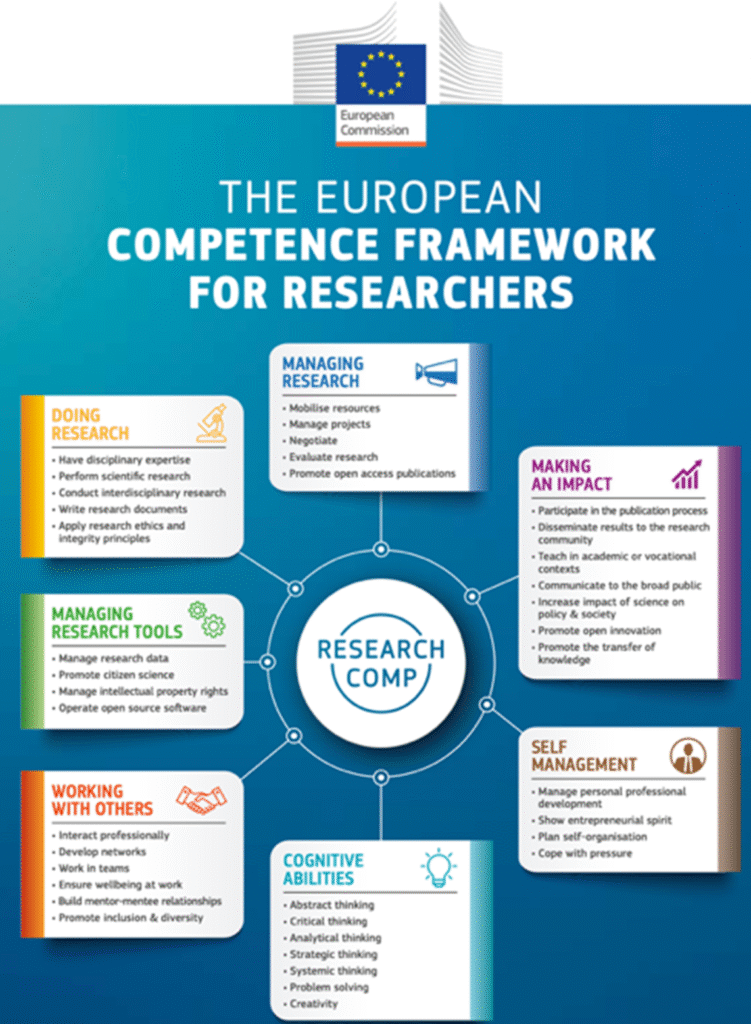
A nivel de competencias, este programa se apoya en el European Competences Framework for Researchers -ResearchComp para diseñar los documentos guía para los mentores (que se apoyarán también en el Programa REBECA de FECYT).
ERA TALENT Call for Multiplying the Impact of EURAXESS Hubs
 Since February 2025, a project belonging to the ERA TALENT Call for Multiplying the Impact of EURAXESS Hubs has been underway. This project has received funding from the European Union’s Horizon Europe research and innovation programme within the framework of the ERA TALENT Project funded under grant agreement No 101103476.
The project will contribute significantly to the impact of MIA, improving the Euraxess service by supporting researchers who wish to continue in academia, training mentors, helping research managers to establish an appropriate methodology for implementing the Programme, designing a training plan (with special attention to psychosocial aspects) based on the needs of mentors, planning materials that enable them to train future mentors, and discovering resources that serve as complementary information and feed into the Career Development Platform (CDP).
The expected results are the design of an appropriate training plan, with special attention to training the trainers, and the compilation of resources and information tools to be used in the programme. It is hoped that this will increase the motivation and involvement of mentors, who will have better skills and competencies useful for their own professional development, and mentees who will have learned to work on their career plans and face the challenges of academia.

